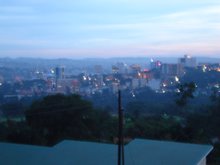
The Commonwealth Heads of Government Meeting (CHOGM) is currently under way in Kampala, ending tomorrow. Before moving to Kampala in March I had never heard of CHOGM; in the past eight months, it’s all I’ve heard about. Billboards around the city demanded, “Are You Ready for CHOGM?” Then billboards featuring local celebrities appeared, announcing, “I Am Ready for CHOGM!” While I’m quite certain the radio DJs and football players have been ready for months, what I’m wondering—while I’m sitting here in Massachusetts in front of the fire wearing a wool turtleneck sweater and eating open-faced turkey sandwiches followed by leftover pecan pie—are the roads ready? Is there electricity? Constant water supply? TB-free beef? Is, in fact, Kampala—and the rest of Uganda—ready?
CHOGM is hosted every two years by a different former Commonwealth nation. Though it has been around in some form or another since 1887, when the meetings were known as Colonial Conferences, the CHOGM title was only adopted in 1971. The purpose of the meetings is to “discuss global and Commonwealth issues, and to agree collective policies and initiatives.” Other cities that have hosted CHOGM include Valletta, Abuja, Coolum (in 2001 the meeting was moved to this smaller site in Australia for security reasons), Durban, Edinburgh, Auckland, Cyprus, Harare, Kuala Lumpur, Vancouver, and London on a few occasions. But I doubt any of those cities have put as much hope in the event as Kampala.
For those of us who have been speculating for months on what the horrors of CHOGM could be—people stuck in their houses without water or electricity with all of the roads blocked and the supermarkets sold out—I imagine CHOGM will actually be a lot like Y2K. A lot of hype, a lot of preparation, and when the event actually happens, little actual chaos.
Yesterday 53 presidents and prime ministers descended on Uganda, plus Queen Elizabeth II, plus 5,000 delegates. Another leg of the advertising campaign has billboards that read: “1.6 billion pairs of eyes on Uganda.” I find this idea of so many disembodied eyes a little creepy and somewhat frightening, considering the current state of affairs.
New hotels have been built all over the city (and no one seems to be asking who will fill these hotels once CHOGM is over), massive structures in peach concrete with purple highlights. Before we left a little less than two weeks ago, I found that the spots on the side of the road where massive piles of garbage are regularly burned have been moved out of sight, though not out of smell. From our apartment on the hill we could still see the plumes of smoke rising through the trees below us. My favorite roadside vegetable stand had also disappeared; I suppose its disintegrating yellow façade was considered an eyesore. Vendors of earthenware giraffes and planters were allowed to remain; small boys who sell bananas from baskets on top of their heads were not. Trees and flowers had been planted. Women in headscarves crouched in the street attempted to keep the ubiquitous red Ugandan dirt off the pavement with bundles of sticks tied together that acted as brooms. Everything seemed more orderly and in many ways less Ugandan.
Before I left, the electricity was out more often. Our water disappeared for days at a time; a disconcerting sucking noise was all that emitted from our faucets when we turned them on. Internet connections—once slow and intermittent on the best of days—were often nonexistent at the variety of cafés I regularly visit. Our apartment is on top of one of Kampala’s seven hills and every road off the hill was blocked with construction. Was this all related to CHOGM? Did everything have to stop functioning before in order to be functioning now?
Like most expatriates, I don’t work for an NGO or at an embassy. I sit at home all day and work on my novel. In this limited capacity I have discovered Kampala’s root problem.
It’s the roads.
Kampala can’t take itself seriously as a city until it fixes its roads. In their most natural form they are kept in atrocious condition. They are riddled with debilitating, axle-breaking potholes. The city sends out a few guys who work a quick fix. First they cut out square sections surrounding the pothole with six-inch rims, which they leave in place for a few days. While I might have been able to navigate the pothole in second gear, it will now be necessary to use to first gear to drop the six inches into the square ditch and back up again. Eventually the men come back to fill the squares with overflowing cement, making the pavement uneven and still quite jarring. Rain only delays things. While they work and close half the road, a man with red and green flags (used indiscriminately) might be there to tell you when it’s safe to pass, or he might not. He might be eating lunch. Or just resting. These quick fixes deteriorate at a rapid rate until the potholes once more appear, less than three months after the road was closed for four days so the potholes could be “fixed.” Construction, deconstruction, and reconstruction are constant.
The second problem with the roads is a lack of traffic signals. Of the handful of traffic lights in the city, only one or two work at any given time. Most of Kampala’s electricity is generated from hydroelectric plants based on tributaries to the Nile River near Lake Victoria, about 35 kilometers away from the city. Water levels dropped in 2005 and 2006 and since then energy has been in short supply. Two diesel-fueled generators have been constructed in Kampala, but they are an expensive and insufficient solution to the problem. To cope, the city is forced to practice constant load shedding, mostly affecting the poorer neighborhoods, but often also taking out traffic lights in the process. The police send wardens to direct traffic during rush hours, but they often seem to do more harm than good. A piece in the local paper the Daily Monitor recently suggested that some wardens tamper with the traffic signals in order to create more work for themselves. The same piece also claimed that many drivers do not understand the meanings of these new-fangled traffic lights and so they choose the wrong lanes and clog intersections in their confusion.
Compounding the lack of traffic signals is the increased number of cars on the road. Between 1997 and 2001 the number of new cars on the road increased each year by an average of a little over 7.5%, and current conditions indicate the same has been true in more recent years. As Uganda’s economy continues to grow, so do the number of drivers on the road. There may be more cars, but there certainly aren’t more roads. There are no incentives for carpooling. There are no highways to ease traffic.
The city council, however, did choose to install the seemingly brilliant idea of solar and wind-powered streetlights along stretches of downtown byways. Kampala is a dark and sometimes scary place to drive at night, and not just because Ugandan drivers are for some reason reluctant to turn on their headlights. What streetlights are available are inadequate for making out the potholes. And so these solar and wind-powered streetlights downtown sounded like a welcome and cost-effective addition to the dark roadways. If only they worked. When they do work the power generated by the turbines or solar cells are insufficient to provide adequate lighting. The bulbs are just a dim reminder of the myriad failures of Kampala’s road maintenance.
I’ve written here about how many times J and I have been pulled over by the police. Only once has someone not asked for a bribe. Traffic police must be enforced to stop drivers for real traffic violations and not simply in hopes of padding their wallets with the shillings of white visitors. But corruption is a huge and widespread problem on a much larger scale, as well.
Since gaining independence from England on October 9, 1962, Uganda has had only three presidents: Milton Obote (1962-1971, 1979-1986), Idi Amin (1971-1979), and now Yoweri Museveni, who led the National Resistance Movement and took power after the second Obote government in 1986. Uganda established its constitution in 1995 and the following year Museveni was officially elected to his first five-year term, then re-elected in 2001. At the end of Museveni’s second term in office, he pressured parliament to change the constitution, dissolving any term limit and allowing himself to run for a third term, which he won easily in February 2006. He has already announced that he will run for a fourth term in 2011, despite pleas from his own people and international leaders to step down. He recently scoffed at Mozambique’s former president Mr. Chissano for suggesting Museveni leave office in order to win the $5 million Mo Ibrahim Prize for Achievement in African Leadership. (Mr. Chissano left office in 2004, forgoing a third term for which he was eligible, and was the first winner of the Prize.)
Though Museveni has been lauded for bringing a country ravaged by the horrors of the Amin regime, followed by a period of further corruption and political upheaval during Obote II, to a one of relative stability—by promoting economic growth, encouraging the return of the Asian community, expanding freedom of the press, and appointing a Human Rights Commission. Twenty years later, though, it might be time for fresh ideas, no?
For CHOGM, by the end of 2006 the government approved and spent over 110 billion Ugandan shillings ($64.5 million) to prepare for the meeting. In 2007 alone, Uganda has already approved and will spend an additional 153 billion Ugandan shillings ($89.7 million). That money is being spent on building construction, road construction, and beautification projects, for the most part. Judging by the results, the money seems ill spent. An audit of the spending is expected next year and no one will be surprised when huge chunks of money go unaccounted for. As reported in the Daily Monitor on November 8, CHOGM spokesperson Kagole Kivumbi held a press conference in which he asked reporters not to question how CHOGM funds have been spent. “These are issues we need not discuss during CHOGM…CHOGM will end in 20 days, and then we can deal with these other issues,” Kivumbi said.
Boda bodas and matatus are what amounts to public transportation in Uganda. Boda bodas are scooters driven by guys in colorful winter parkas (despite the 80 degree heat) and sunglasses but without helmets. They crowd the roads and are extremely dangerous. Darting in and out of traffic to avoid jams, they pass on either side of your car without warning. Shortly after arriving in country, I saw a small piece in the Economist published in early 2007 stating Uganda would be ridding the roads of boda bodas in preparation for the Queen’s visit. But boda bodas are like cockroaches; there is no getting rid of them. The city council has posted small signs demarcating boda stands and here twenty men on bikes will gather and yell out “Muzungu! Muzungu!” (the Luganda word for white person) when I pass. Picture packs of Hells Angels all over the city—a little less tough, wearing less black, and with smaller bikes.
Matatus are white minivans that are supposed to hold only 14 people, but often carry many more than that. There is one main taxi park in downtown Kampala and matatus are either heading toward the taxi park, or away. If they have regular routes, it’s a mystery to me. They pull in and out of traffic without warning. They break down often and prefer to do so in the middle of an intersection. There are no designated areas for them to stop on the roads—it could be anywhere. One popular stop on a two-lane road I frequent has no turn-off, the matatu just stops in the outer lane, funneling everyone else into the inner lane and causing a traffic jam.
Bodas are accidents waiting to happen and there are an estimated 1 million of them in Uganda. Matatus—an estimated 8,500 strong—aggravate already bad traffic. They need official stops. Both need to be regulated. A public bus system with full-size buses was announced to be in place by CHOGM, but it has yet to materialize.
Finally, for a country that is in a rainy season almost half the year, it has yet to learn how to handle them. Rains are crippling. Poor drainage systems create flash floods in the smallest of rainstorms. Even when not in an actual rainy season, afternoon storms are a common occurrence. If it’s raining, I don’t go out. It can take an hour after the storm ends for a flooded road to clear of traffic.
Even if Uganda managed to solve the problems with its roads, it still faces another major challenge: the Uganda driver. Uganda has plain terrible drivers. They have their own peculiar system for using their blinkers. A boda might keep their right blinker on as it cruises along the outer left-hand side of the road not because he plans on turning right across traffic any time soon, but just so you’ll know he’s there. Pass with caution. When a car or boda actually wants to turn, it turns the blinker off. I’ve pulled up to an intersection where the only option is to go left on a one-way street and the car in front of me will put on his right blinker, and then turn left. It is common to pass other cars on blind curves, to pull out onto a street without looking, or to pull out and then look and then stop in the middle of the road, forcing oncoming traffic to stop and wave the person on. (In researching this entry, I discovered a right signal can mean a warning against other cars against passing, while a left signal indicates it’s okay to pass. Or the person could just be turning. Or neither. Who knows? I’m not sure the person in the car knows.)
Traffic jams are endemic because of the bad drivers, the bad roads with their bad drainage outlets, the bad traffic signals, the bad cops, and the bad public transportation, which are all themselves representative of much larger problems: a lack of proper infrastructure and an honest government which knows how to implement funding properly to promote public works.
Is Uganda ready for CHOGM? They might pull it off. They’ll tidy the route the Queen is taking in her motorcade so that she experiences a clean, smooth, flawless ride, giving her a false impression of a universal Ugandan experience. Kampala’s politicians are probably patting themselves on the back for getting everything prepared in time, but does anyone care that it will all be a lie? Is the point really to deceive the Queen of England and the 53 other heads of government into believing Uganda is a country that is functioning perfectly well? Why not show them the true Kampala—with its slums and shanty roadside markets, its epic traffic jams and jolting rides through town, its smoking garbage piles, its crazy drivers, its blackouts and water shortages—and then see what they can do to help?
When I return to Kampala in December, the roads will still be freshly paved—for three months at least. And then they will start to deteriorate again and when they do, without CHOGM looming in the future, what will be the incentive to repair them?
Friday, November 23, 2007


Wednesday, November 14, 2007
An Africa Morning Right Here in America
Apologies for the overlong silence. I arrived back in the States on Monday for a three week visit—Thanksgiving or CHOGM, not a tough decision to make, and I’m not that good at making decisions. Bring on the turkey. And my heart goes out to all you turkeys stuck in Uganda this month. Go buy more water. Now.
I called my doctor’s office this morning just after it opened to make an appointment. A receptionist informed me that all of the schedulers were in a meeting, but one would call me as soon as the meeting ended. An hour later I still hadn’t heard from anyone so I called back. This time the computers were down and no appointments could be booked until they were back up.
Whoa! Computers go down in America?? (In my six months absence, have I glorified “home” perhaps a little too much?) I hung up the phone thinking to myself, but I thought I left Africa.
I called back an hour later but the computers had still not been restored. By lunchtime I gave up on ever receiving a call back and went to the grocery store. Rediscovering old favorites? Priceless. Favorite buys: frozen sweet potato fries, Us Weekly, cranberry juice, red seedless grapes, and my number one craving while in Uganda, Ben & Jerry’s Chocolate Chip Cookie Dough ice cream. (I didn’t even eat this flavor ice cream all that much before we moved, but boy did I miss it.) Actually, not so priceless. I spent $87 on what amounted to, essentially, a whole bunch of snacks.
Posts will be sporadic these next couple of weeks. Also, I forgot the chord that connects the camera to the computer, so pictures will be nonexistent until I get back to Uganda.
For those readers who have passed through the Entebbe airport, has that stuffed impala always been outside the departure gates, or is that part of the multi-million dollar refurbishing? If so, I say money well spent! Perhaps the best spent of all the $150 million CHOGM money across the entire country…
I called my doctor’s office this morning just after it opened to make an appointment. A receptionist informed me that all of the schedulers were in a meeting, but one would call me as soon as the meeting ended. An hour later I still hadn’t heard from anyone so I called back. This time the computers were down and no appointments could be booked until they were back up.
Whoa! Computers go down in America?? (In my six months absence, have I glorified “home” perhaps a little too much?) I hung up the phone thinking to myself, but I thought I left Africa.
I called back an hour later but the computers had still not been restored. By lunchtime I gave up on ever receiving a call back and went to the grocery store. Rediscovering old favorites? Priceless. Favorite buys: frozen sweet potato fries, Us Weekly, cranberry juice, red seedless grapes, and my number one craving while in Uganda, Ben & Jerry’s Chocolate Chip Cookie Dough ice cream. (I didn’t even eat this flavor ice cream all that much before we moved, but boy did I miss it.) Actually, not so priceless. I spent $87 on what amounted to, essentially, a whole bunch of snacks.
Posts will be sporadic these next couple of weeks. Also, I forgot the chord that connects the camera to the computer, so pictures will be nonexistent until I get back to Uganda.
For those readers who have passed through the Entebbe airport, has that stuffed impala always been outside the departure gates, or is that part of the multi-million dollar refurbishing? If so, I say money well spent! Perhaps the best spent of all the $150 million CHOGM money across the entire country…
Tuesday, November 6, 2007
The Fabled Kisiizi Falls
In the morning J and N. went off to the clinic for the day. P. returned to the hotel where I presented him with my Bradt Uganda guide and showed him the map of Queen Elizabeth National Park. It looked to be only 50 or so kilometers from Rukungiri, but P. confirmed it involved backtracking before continuing north and once we got to the Park, he didn’t think his sedan would be able to handle the rough dirt roads. Ishasha, in the southern section of the Park and home to the tree-climbing lions, looked closer and more accessible. P. called one of the campsites, but they said it had been raining and the roads would definitely be unmanageable in P.’s car.
So we shut the book and I announced I was going to walk around town. P. liked the idea and we set off on foot. Though Rukungiri is bigger than most of the villages we passed through, I quickly realized our walk through town would take all of twenty minutes.

The day yawned before me. I spent ten minutes in an Internet café and when I came out, P. said, “We go back?” and I shrugged and said, without much hope, “Do you think there’s anything else to see?” P. responded “Let me ask someone.” What I love about traveling with P. is he takes care of business. He’ll talk to anyone to get the information we need and never puts me in the uncomfortable position of trying to communicate with people and look like an idiot Muzungu.
P. stopped a man nearby and he asked what we’re looking for. Since we didn’t really know, we told him, “anything worth seeing.” A second man stopped and suggested a hotel. We shook our heads. We were not particularly interested in visiting another hotel. The first man suggested a second hotel. “Anything else?” P. asked. The second man said rather casually, “Well, then there are the Falls.”
It’s a tactic I might use on a small child, asking with excitement if the small child would like to go pick up my dry cleaning with me or watch paint dry and then in a bored voice say, “Or we could ride the ponies.”
Of course I wanted to go the Falls!
The man said they were 30 kilometers away, which P. and I agreed was not so bad. It was only 10:30 AM, J and N. would not need to be picked up from the clinic until 5:00 PM at the earliest, and still I figured we would be back at the hotel by 2:00 PM. P. got directions and we walked back to the hotel to get the car.
For the first 15 kilometers we were on the paved, surface road. Then we turned off onto a dirt track. We passed through a village and then rode through hilly farmlands without a house in sight. Five kilometers in we passed a large farmhouse and then another couple of kilometers on another small village. If I thought Rukungiri town was the middle of nowhere, these people were in the middle of the middle of nowhere. We passed only the occasional pick-up truck carrying a bed full of workers. There was no water in sight.

Ten kilometers in we crossed a small bridge over a swamp of standing water. We took this as a good sign. The Falls could not be much farther. We came upon two men with a herd of cattle and asked them how much farther it was to the Falls. They thought maybe another ten kilometers. We went on.
After another seven kilometers, we passed through another village and stopped again to ask how much farther. An old man told it was about ten kilometers.
“Still?” I asked P.
“That’s what the man says.”
“This is turning out to be very far. Should we turn around?”
“We have come this far,” P. said and went on.
We crested a hill and could see the dirt track stretch out before us and pass between two hills. “It must be beyond those hills,” P. said. But when we got to the hills, there was nothing on the other side except another small village and still no water to be found. Ahead of us the road turned from its dusty, pale, hard track into a soft, dark patch of fresh earth. A tractor stood on the side of the road, but had not yet matted the road. “If it rains, we will be stuck on the other side. I will not be able to pass over this again,” P. said. Both ahead and behind dark clouds shadowed the horizon.
“Will it rain soon, do you think?” I asked.
“Very soon,” P. said.
“Maybe we should turn around.”
“We have come this far,” P. said and drove on.
By then it was close to 12:30 and my stomach started to grumble. I ate an apple. Lunch was a long time away. We had driven 40 kilometers and I began to think how typically Ugandan the situation was, for someone to tell us something was 30 kilometers away and have it turn out to be much more than that. An easy trip quickly morphing into a long adventure. We stopped another man and asked him how far to the Falls.
“The Falls?”
Yes.
“Kisiizi Falls?”
Yes.
He considered it and then said, “25 kilometers.”
I was distraught. “P., it’s too far. We should just turn around.”
But we had come this far.

We found a gas tank in the middle of a dirt track on the side of the road. A man pumped gasoline into our tank by turning a lever. We asked how far it was to the Falls.
10 kilometers.
We drove another ten kilometers and yes, finally hit the town of Kisiizi. P. stopped and asked a man how to find the Falls.
“The Falls?” Blank stare.
Yes, Kisiizi Falls.
More blank stare. “You should ask someone at the Hospital.”
I was quite sure now the fabled Kisiizi Falls was an elaborate joke played on Muzungu tourists. Let them drive 50 kilometers into the middle of nothingness only to find more nothingness. We parked by the Hospital, a fairly substantial complex of buildings and bandas with a handful of Muzungu doctors walking around in white lab coats.
We accosted a small boy to show us the way to the Falls, but he seemed confused on which direction to go. An older man came up to see what the problem was. After what seemed to be a rather elaborate set of directions, P. asked a question. The man sighed and took off down the road, waving for us to follow. We passed through the hospital grounds and a series of fences that brought us through a cow field. The man walked at an increasingly faster pace until he was practically jogging across the field.

Finally I heard the Falls. The man trotted up a hill and I fell behind to take pictures. When I came up to the top, he and P. were deep in conversation in Luganda. I caught my breath, took pictures, tried not to think about when I might eat lunch, and tried to look grateful for finding the Falls. I paid the man less than a dollar for his troubles, which he seemed very happy to receive, and he left.

After such a long journey, P. and I felt like we had to put some time in at the falls, appreciating their beauty. The path ended a good distance from the water with no negotiable path down. The falls themselves were thirty to forty feet high and it seemed impossible to reach the top from where we stood. I felt five minutes were sufficient.
And then we left and drove the 50 kilometers back to town, during which time I was in a sort of hunger-induced waking sleep that made the return trip go by rather quickly.
So we shut the book and I announced I was going to walk around town. P. liked the idea and we set off on foot. Though Rukungiri is bigger than most of the villages we passed through, I quickly realized our walk through town would take all of twenty minutes.

The day yawned before me. I spent ten minutes in an Internet café and when I came out, P. said, “We go back?” and I shrugged and said, without much hope, “Do you think there’s anything else to see?” P. responded “Let me ask someone.” What I love about traveling with P. is he takes care of business. He’ll talk to anyone to get the information we need and never puts me in the uncomfortable position of trying to communicate with people and look like an idiot Muzungu.
P. stopped a man nearby and he asked what we’re looking for. Since we didn’t really know, we told him, “anything worth seeing.” A second man stopped and suggested a hotel. We shook our heads. We were not particularly interested in visiting another hotel. The first man suggested a second hotel. “Anything else?” P. asked. The second man said rather casually, “Well, then there are the Falls.”
It’s a tactic I might use on a small child, asking with excitement if the small child would like to go pick up my dry cleaning with me or watch paint dry and then in a bored voice say, “Or we could ride the ponies.”
Of course I wanted to go the Falls!
The man said they were 30 kilometers away, which P. and I agreed was not so bad. It was only 10:30 AM, J and N. would not need to be picked up from the clinic until 5:00 PM at the earliest, and still I figured we would be back at the hotel by 2:00 PM. P. got directions and we walked back to the hotel to get the car.
For the first 15 kilometers we were on the paved, surface road. Then we turned off onto a dirt track. We passed through a village and then rode through hilly farmlands without a house in sight. Five kilometers in we passed a large farmhouse and then another couple of kilometers on another small village. If I thought Rukungiri town was the middle of nowhere, these people were in the middle of the middle of nowhere. We passed only the occasional pick-up truck carrying a bed full of workers. There was no water in sight.

Ten kilometers in we crossed a small bridge over a swamp of standing water. We took this as a good sign. The Falls could not be much farther. We came upon two men with a herd of cattle and asked them how much farther it was to the Falls. They thought maybe another ten kilometers. We went on.
After another seven kilometers, we passed through another village and stopped again to ask how much farther. An old man told it was about ten kilometers.
“Still?” I asked P.
“That’s what the man says.”
“This is turning out to be very far. Should we turn around?”
“We have come this far,” P. said and went on.
We crested a hill and could see the dirt track stretch out before us and pass between two hills. “It must be beyond those hills,” P. said. But when we got to the hills, there was nothing on the other side except another small village and still no water to be found. Ahead of us the road turned from its dusty, pale, hard track into a soft, dark patch of fresh earth. A tractor stood on the side of the road, but had not yet matted the road. “If it rains, we will be stuck on the other side. I will not be able to pass over this again,” P. said. Both ahead and behind dark clouds shadowed the horizon.
“Will it rain soon, do you think?” I asked.
“Very soon,” P. said.
“Maybe we should turn around.”
“We have come this far,” P. said and drove on.
By then it was close to 12:30 and my stomach started to grumble. I ate an apple. Lunch was a long time away. We had driven 40 kilometers and I began to think how typically Ugandan the situation was, for someone to tell us something was 30 kilometers away and have it turn out to be much more than that. An easy trip quickly morphing into a long adventure. We stopped another man and asked him how far to the Falls.
“The Falls?”
Yes.
“Kisiizi Falls?”
Yes.
He considered it and then said, “25 kilometers.”
I was distraught. “P., it’s too far. We should just turn around.”
But we had come this far.

We found a gas tank in the middle of a dirt track on the side of the road. A man pumped gasoline into our tank by turning a lever. We asked how far it was to the Falls.
10 kilometers.
We drove another ten kilometers and yes, finally hit the town of Kisiizi. P. stopped and asked a man how to find the Falls.
“The Falls?” Blank stare.
Yes, Kisiizi Falls.
More blank stare. “You should ask someone at the Hospital.”
I was quite sure now the fabled Kisiizi Falls was an elaborate joke played on Muzungu tourists. Let them drive 50 kilometers into the middle of nothingness only to find more nothingness. We parked by the Hospital, a fairly substantial complex of buildings and bandas with a handful of Muzungu doctors walking around in white lab coats.
We accosted a small boy to show us the way to the Falls, but he seemed confused on which direction to go. An older man came up to see what the problem was. After what seemed to be a rather elaborate set of directions, P. asked a question. The man sighed and took off down the road, waving for us to follow. We passed through the hospital grounds and a series of fences that brought us through a cow field. The man walked at an increasingly faster pace until he was practically jogging across the field.

Finally I heard the Falls. The man trotted up a hill and I fell behind to take pictures. When I came up to the top, he and P. were deep in conversation in Luganda. I caught my breath, took pictures, tried not to think about when I might eat lunch, and tried to look grateful for finding the Falls. I paid the man less than a dollar for his troubles, which he seemed very happy to receive, and he left.

After such a long journey, P. and I felt like we had to put some time in at the falls, appreciating their beauty. The path ended a good distance from the water with no negotiable path down. The falls themselves were thirty to forty feet high and it seemed impossible to reach the top from where we stood. I felt five minutes were sufficient.
And then we left and drove the 50 kilometers back to town, during which time I was in a sort of hunger-induced waking sleep that made the return trip go by rather quickly.
Monday, November 5, 2007
Rukungiri or Bust
J had business to attend to in Western Uganda, so I decided to tag along. We hired P. to do the driving and he picked us up Sunday afternoon for the five-plus hour drive to Rukungiri.

Most cars in Uganda don’t really do air conditioning, despite the constant equatorial heat, and we rode with the windows down through the green countryside, interspersed with matooke fields and tiny villages of concrete structures painted in alternating colors of red (for Celtel), yellow (for MTN), and blue (for Uganda Telecom)—all advertising cell phone companies. Occasionally you’ll also the see the green for Tororo Cement. These villages have the feel of a movie set for a Hollywood Western, a ghost town, mere facades with nothing behind them. There are people in front—tiny children running about without any seeming supervision, women cooking, men eating and drinking, people darting into the middle of the road to sell goat meat on a stick to passers-by, women walking with absurd loads on their heads like a stack of chairs or a pile of lumber that I’m quite certain would bring me to my knees if not to a complete lying down position—but behind all this nothing but fields. As we passed through the bigger towns of Mbarara and Masaka, Coke signs dominated the roadside, the new flowery logo sprouted up over each directional posting—every school, hospital, hotel, and university building lived on the Coke side of life.
Rukungiri is a town that does not even qualify an entry in the Bradt guide. By the time we grew close it was dark and chilly, a chill I haven’t felt since leaving New York in March. When we woke up we were surprised to find ourselves in the mountains. Well, if not exactly the mountains, some big hills. It’s beautiful, rolling, green country and from our hotel we could see for miles.

We stayed in the best hotel in town, the Rukungiri Inn, with a floorplan like one of those mazes you stick mice in. They even have DSTV and when we arrived Sunday evening half the town was filing out of the place after watching the Liverpool-Arsenal game. In our room we checked to see what other channels were available, but it turns out there’s just one channel and that channel is whatever the people in charge of the hotel decide to watch. You could be getting into a really bad Ashley Judd movie on the movie channel and all of a sudden, just when Ashley Judd is getting drunk again and about to go home with a real sleezeball at the bar, the channel changes to Big Brother Africa and everyone in the house is sleeping. (Big Brother Africa is on 24 hours/day on one channel. Amazing.)
For the trip we had braced ourselves for 24/7 Ugandan food, which is not our favorite type of food ever and since there is little variety and a lot of starches, it can get quite old quite fast. But the Rukungiri Inn, we were pleasantly surprised to discover, had curries and cheese sandwiches on the menu, as well. I had my first Rolex, technically a Ugandan invention as fast I can tell, in which a fried egg and sometimes cheese is rolled up in a chapati. The best thing I’ve had here in a long time.

Most cars in Uganda don’t really do air conditioning, despite the constant equatorial heat, and we rode with the windows down through the green countryside, interspersed with matooke fields and tiny villages of concrete structures painted in alternating colors of red (for Celtel), yellow (for MTN), and blue (for Uganda Telecom)—all advertising cell phone companies. Occasionally you’ll also the see the green for Tororo Cement. These villages have the feel of a movie set for a Hollywood Western, a ghost town, mere facades with nothing behind them. There are people in front—tiny children running about without any seeming supervision, women cooking, men eating and drinking, people darting into the middle of the road to sell goat meat on a stick to passers-by, women walking with absurd loads on their heads like a stack of chairs or a pile of lumber that I’m quite certain would bring me to my knees if not to a complete lying down position—but behind all this nothing but fields. As we passed through the bigger towns of Mbarara and Masaka, Coke signs dominated the roadside, the new flowery logo sprouted up over each directional posting—every school, hospital, hotel, and university building lived on the Coke side of life.
Rukungiri is a town that does not even qualify an entry in the Bradt guide. By the time we grew close it was dark and chilly, a chill I haven’t felt since leaving New York in March. When we woke up we were surprised to find ourselves in the mountains. Well, if not exactly the mountains, some big hills. It’s beautiful, rolling, green country and from our hotel we could see for miles.

We stayed in the best hotel in town, the Rukungiri Inn, with a floorplan like one of those mazes you stick mice in. They even have DSTV and when we arrived Sunday evening half the town was filing out of the place after watching the Liverpool-Arsenal game. In our room we checked to see what other channels were available, but it turns out there’s just one channel and that channel is whatever the people in charge of the hotel decide to watch. You could be getting into a really bad Ashley Judd movie on the movie channel and all of a sudden, just when Ashley Judd is getting drunk again and about to go home with a real sleezeball at the bar, the channel changes to Big Brother Africa and everyone in the house is sleeping. (Big Brother Africa is on 24 hours/day on one channel. Amazing.)
For the trip we had braced ourselves for 24/7 Ugandan food, which is not our favorite type of food ever and since there is little variety and a lot of starches, it can get quite old quite fast. But the Rukungiri Inn, we were pleasantly surprised to discover, had curries and cheese sandwiches on the menu, as well. I had my first Rolex, technically a Ugandan invention as fast I can tell, in which a fried egg and sometimes cheese is rolled up in a chapati. The best thing I’ve had here in a long time.
Saturday, October 27, 2007
Short Hiatus
I'll be in Western Uganda until Thursday. Since I'm unsure of what the Internet availability will be like, I'm not planning any entries until I return.
Friday, October 26, 2007
Africa: Where Clothes Come to Die
These are the buckets in which Joan washes our clothes:

This is the clothesline on which our clothes dry:

After eight months in Uganda, we have holes in everything (the discoloration is a mystery to me as Joan does not use any bleaching products when she washes; notice also the distortion in the neckline, many of my crewnecks have become V-necks):

Shoes are no exception, though obviously the holes in our shoes have nothing to do with the buckets and the clotheslines. But we did quickly learn never to leave canvas shoes outside. Don't ask me what eats the canvas, but something does:

These were so beat up, J left them in Egypt:

On the bright side, it seems that our bags will be significantly lighter when we return from Uganda. More room for salad tongs and animals made of wire and beads!
Eulogy for Pants
In late 2001, when I was preparing to leave Boston and move to New York, for the first time in my life I paid over $100 for a pair of jeans. They were a pair of Sevens, when Sevens were still new and the fact that a pair of jeans could make someone’s ass look that good was a phenomenon.
I had my friend B. with me. B. is the person you want with you when you are buying a pair of jeans, or any article of clothing really. B. was born with fashion magic embedded in her little stubby fingertips. When you try something on in the store, she can tell if it’s something you’ll want to wear every day for the rest of your life or if you’ll wear if once and then regret ever buying it. It’s one of her many gifts.
B. sent me into the dressing room with a stack of jeans and when I came out in the black Sevens, I cried, “They’re too tight!” and B. said, “They’ll stretch!” and I said, “I think I need a bigger size,” and B. said, “Don’t do it.” And because I trust B. with my fashion life, I took her advice. She was right. (She’s always right.) They were the perfect pair of jeans for three years.
Then they stretched a little too much and they became Sunday jeans. Soft and comfortable, they were more soothing than a VitaWater and bagel sandwich when I had a hangover on a Sunday morning.
A few months before leaving New York to move here, small holes developed in the crotch. It seems the pants wanted only to live in New York. I sewed the holes shut and continued to wear them. After each washing here, the holes slowly grew larger, burst their amateur darning, and morphed into a monster shredding (recently patched):

It was the spring of 2002, a few months after I arrived in New York, and I took my measly publishing paycheck to a consignment store called Tokyo 7 in the East Village, which sold only lightly worn designer clothing. There I bought my first pair of Marc Jacobs pants for $50. They fit like a dream, had a nice texture to the fabric, were just a little bit short in the leg, which I liked. They looked amazing with flats.
There were no hints of rebellion. One day the crotch simply opened up. I search for a way to fix them, but the tear was not a simple rip along the seam, but had started there and exploded into a complete disintegration of crotch:

So, is it me? Is it my crotch?
Or is it Africa with its lack of washing machines?
Or is it the pants companies, purposefully distressing the fabric in the crotch so it wears out in two to three years, forcing customers to return to them over and over?
Who do I blame, third world Africa or corporate America? I suppose that’s going to depend on my mood.
Or am I just asking too much of my pants?

This is the clothesline on which our clothes dry:

After eight months in Uganda, we have holes in everything (the discoloration is a mystery to me as Joan does not use any bleaching products when she washes; notice also the distortion in the neckline, many of my crewnecks have become V-necks):

Shoes are no exception, though obviously the holes in our shoes have nothing to do with the buckets and the clotheslines. But we did quickly learn never to leave canvas shoes outside. Don't ask me what eats the canvas, but something does:

These were so beat up, J left them in Egypt:

On the bright side, it seems that our bags will be significantly lighter when we return from Uganda. More room for salad tongs and animals made of wire and beads!
Eulogy for Pants
In late 2001, when I was preparing to leave Boston and move to New York, for the first time in my life I paid over $100 for a pair of jeans. They were a pair of Sevens, when Sevens were still new and the fact that a pair of jeans could make someone’s ass look that good was a phenomenon.
I had my friend B. with me. B. is the person you want with you when you are buying a pair of jeans, or any article of clothing really. B. was born with fashion magic embedded in her little stubby fingertips. When you try something on in the store, she can tell if it’s something you’ll want to wear every day for the rest of your life or if you’ll wear if once and then regret ever buying it. It’s one of her many gifts.
B. sent me into the dressing room with a stack of jeans and when I came out in the black Sevens, I cried, “They’re too tight!” and B. said, “They’ll stretch!” and I said, “I think I need a bigger size,” and B. said, “Don’t do it.” And because I trust B. with my fashion life, I took her advice. She was right. (She’s always right.) They were the perfect pair of jeans for three years.
Then they stretched a little too much and they became Sunday jeans. Soft and comfortable, they were more soothing than a VitaWater and bagel sandwich when I had a hangover on a Sunday morning.
A few months before leaving New York to move here, small holes developed in the crotch. It seems the pants wanted only to live in New York. I sewed the holes shut and continued to wear them. After each washing here, the holes slowly grew larger, burst their amateur darning, and morphed into a monster shredding (recently patched):

It was the spring of 2002, a few months after I arrived in New York, and I took my measly publishing paycheck to a consignment store called Tokyo 7 in the East Village, which sold only lightly worn designer clothing. There I bought my first pair of Marc Jacobs pants for $50. They fit like a dream, had a nice texture to the fabric, were just a little bit short in the leg, which I liked. They looked amazing with flats.
There were no hints of rebellion. One day the crotch simply opened up. I search for a way to fix them, but the tear was not a simple rip along the seam, but had started there and exploded into a complete disintegration of crotch:

So, is it me? Is it my crotch?
Or is it Africa with its lack of washing machines?
Or is it the pants companies, purposefully distressing the fabric in the crotch so it wears out in two to three years, forcing customers to return to them over and over?
Who do I blame, third world Africa or corporate America? I suppose that’s going to depend on my mood.
Or am I just asking too much of my pants?
Monday, October 22, 2007
Interrogated
Last week I met a friend at Efendy’s for dinner. Efendy’s is a Turkish restaurant located in Centenary Park, an area devoted to five or six restaurants across an expanse of greenery. As I pulled into the drive, I was stopped, for the first time, by a guard.
Me: Is everything okay?
Guard: Everything is okay, maybe.
Pause.
Me: Okay.
Guard: Where are you going?
Me: Efendy’s.
Guard: Are you carrying any firearms?
Me: (laughter, then realizing he is being serious) Oh, no firearms.
Guard: Now everything is okay.
The system does not exactly seem foolproof, does it?
Me: Is everything okay?
Guard: Everything is okay, maybe.
Pause.
Me: Okay.
Guard: Where are you going?
Me: Efendy’s.
Guard: Are you carrying any firearms?
Me: (laughter, then realizing he is being serious) Oh, no firearms.
Guard: Now everything is okay.
The system does not exactly seem foolproof, does it?
Friday, October 19, 2007
Egypt - Day 5
MTV Europe is mesmerizing. They play videos! All the time! When you’ve had little exposure to American pop culture or television in general for six months, this truly seems like a worthwhile way to spend your time on a Monday morning when you’re in a comfy Sheraton bed in Luxor, Egypt. Eventually we roused ourselves to the pool.
The Sheraton has had the most brilliant idea of putting an ice cream stand right next to the pool at their hotel. Ice cream in waffle cones, blazing heat, vacation—brilliant. (Please note that ice cream in Uganda can taste like shredded pieces of newspaper on all but the most rare occasions.)
In the afternoon we hired our most crazy cab driver of the whole trip and had him take us to Karnak. He spoke quite fast and unintelligibly and turned out to be oddly persuasive. (After coming out of Karnak, J said, “Do you remember what our cab driver looks like?” and I said, “Just look for the crazy man,” and we had no trouble finding him.)
Karnak is vast. Over a 1300-year period, successive pharaohs, in order to make their marks, added to and changed the temple, which began as the Temple of Amun, dedicated to the king of the gods.
Colossus of Ramses II:

Great Hypostyle Hall (it has 134 columns):

From the backside:

J, taking a break:

From there, we had the crazy man drop us at Luxor Temple, and then we had to pay him off to get rid of him.


And the avenue of sphinxes, which once stretched almost 2 kilometers, all the way to Karnak.

We walked back to the hotel as the sun set, ordered room service, watched a movie, and called it a vacation.
The Sheraton has had the most brilliant idea of putting an ice cream stand right next to the pool at their hotel. Ice cream in waffle cones, blazing heat, vacation—brilliant. (Please note that ice cream in Uganda can taste like shredded pieces of newspaper on all but the most rare occasions.)
In the afternoon we hired our most crazy cab driver of the whole trip and had him take us to Karnak. He spoke quite fast and unintelligibly and turned out to be oddly persuasive. (After coming out of Karnak, J said, “Do you remember what our cab driver looks like?” and I said, “Just look for the crazy man,” and we had no trouble finding him.)
Karnak is vast. Over a 1300-year period, successive pharaohs, in order to make their marks, added to and changed the temple, which began as the Temple of Amun, dedicated to the king of the gods.
Colossus of Ramses II:

Great Hypostyle Hall (it has 134 columns):

From the backside:

J, taking a break:

From there, we had the crazy man drop us at Luxor Temple, and then we had to pay him off to get rid of him.


And the avenue of sphinxes, which once stretched almost 2 kilometers, all the way to Karnak.

We walked back to the hotel as the sun set, ordered room service, watched a movie, and called it a vacation.
Wednesday, October 17, 2007
The Third Type of Vacation
A friend recently reminded me that in addition to the beach and ski vacations, there is also the eating and drinking vacation. An excellent point, especially as we are going to Paris in December, which has neither beach nor mountains, and I am very excited about it. Though of course we’ll be seeing the sites and I’m looking forward to just wandering around in that beautiful city again, what I’m really looking forward to is the eating and drinking. Likewise, J and will be in New York for a weekend in November, which will also be an eating vacation. We have already mapped out our restaurants.
One more entry on Egypt coming shortly…
One more entry on Egypt coming shortly…
Monday, October 15, 2007
Egypt - Day 4
Luxor. We did it up and stayed at the Sheraton. Even thought there is absolutely too much to see in Luxor, we made time for the pool because we were dying for some actual “vacation” time.
The train got us into town around 6:00 AM. We checked in at the Sheraton and decided to get right to business in order to beat the heat. We hired a cab for the morning and headed to the West bank of the Nile. Our guide book was last revised in 2005 so we kept waiting for the driver to pull over at one of the ferry landings so we could take a ferry across the river. As far as we knew it was the only was across. But apparently sometime between 2005 and now, a bridge was built and so, no ferry for us.
First stop: Valley of the Kings. Think middle of the desert, think hot, think lots of red-faced tourists wandering about.

There are 62 tombs in the Valley of the Kings and only a select few are open at any one time. The ticket you buy to get into the area allows you access to three tombs. I suppose more diligent tourists would have read up on each of the tombs before going, come up with a list of their top ten preferences, and then, you know, have seen which of those were open, etc. J and I opened our guide book once inside the park and said, this one looks cool.
The Tomb of Tuthmosis III (No. 34, for all you near-future visitors) was built 98 feet above ground and is reached by a long metal staircase.

Once inside, you then have to climb down a narrow, dark, rickety wooden staircase into the tomb. The tomb has two levels. The first is empty, save for the hieroglyphics lining the walls. Down another claustrophobic staircase—not to mention it is quite warm in there with little air circulation—the second level has more hieroglyphics plus a red granite sarcophagus. We climbed back up the stairs behind a fantastically out-of-shape tourist who moved in slow motion so when we came back out into the fresh air we were breathing easily. We sat down to check our book for the next tomb of choice and we were right outside the entrance to the tomb, after you come up the decently long flight of stairs out of the tomb but before you go down the metal staircase 100 feet to level ground. People are out of shape! Most people came out of the tomb sweating, red, and bent over at the knees trying to catch their breath. There’s a thing at the gym called the Stairmaster—if you want to visit the Tomb of Tuthmosis III, hop on.
Next up was No. 14, the Tomb of Queen Twasert/Sethnakht. Originally intended for Queen Twasert, the wife of Seti II, it was appropriated instead by the pharaoh Sethnakht because he was having problems with his own tomb. Photography was not allowed in any of the tombs, but open entering No. 14, J and I found ourselves all alone. We were right by the entrance where the light was still decent and the hieroglyphics on the walls were just spectacular. We might never be allowed back in Egypt for admitting to this, but we took a couple of pictures. And oh man was it worth it. Check this baby out:

Do you just feel like you’re so there?
Anyway, big, awesome, beautiful tomb.
For our last tomb, if I’m remembering correctly, we went next door to Tomb No. 15, which is not listed in the guide book because it’s not important enough. The guy at the entrance said, you guys know this is your last tomb, right? And we were like, yeah, we’re cool with that, and he looked kind of skeptical that we knew what we were doing, but let us in anyway. Way to sell your tomb, dude.
I don’t think you can really go wrong with any of the tombs. I was just as impressed with poor, neglected No. 15 as I was with any of the others. I mean, Tuthmosis III seems to get a lot of props just for being built so high up (fat lot of good that did from keeping the robbers out), but I would say his tomb was much less spectacular than No. 14 or 15.
Our three tombs were up and it was off to Hatshepsut Temple. Right this second, try to pronounce that. Say it aloud. Come on. I dare you. J and I couldn’t the word to save our lives. At first our driver looked at us like we were insane. Where did we want him to take us? But once he figured it out, he found us hilarious. He sounded it out for us. We repeated after him. But we could just not get it. It was beyond us.
Are you still thinking: hot? Because it was hot, people. Look how hot we are:

The temple was built for Queen Hatshepsut in the 18th Dynasty. It’s built into the mountain and looks out over the desert. It’s stunning.


After this we headed back to the hotel for lunchtime, pooltime, naptime, in that order. We had the best of intentions of heading back to the West bank and the Valley of the Queens, etc, but we just never made it.
In the late afternoon we walked into town to check out Luxor Temple, but once we got there we realized we had forgotten the camera and everyone knows if you don’t take pictures it’s like it never happened. So we decided to go back the next day and had a nice leisurely walk along the river and then back to the hotel.
Day 4 in Egypt also happened to be our one-year anniversary. That night we got all gussied up and had dinner at the Italian restaurant at the hotel. We sat outside by a fountain long abandoned to algae and ate mediocre food and it was just lovely. Truly.
The train got us into town around 6:00 AM. We checked in at the Sheraton and decided to get right to business in order to beat the heat. We hired a cab for the morning and headed to the West bank of the Nile. Our guide book was last revised in 2005 so we kept waiting for the driver to pull over at one of the ferry landings so we could take a ferry across the river. As far as we knew it was the only was across. But apparently sometime between 2005 and now, a bridge was built and so, no ferry for us.
First stop: Valley of the Kings. Think middle of the desert, think hot, think lots of red-faced tourists wandering about.

There are 62 tombs in the Valley of the Kings and only a select few are open at any one time. The ticket you buy to get into the area allows you access to three tombs. I suppose more diligent tourists would have read up on each of the tombs before going, come up with a list of their top ten preferences, and then, you know, have seen which of those were open, etc. J and I opened our guide book once inside the park and said, this one looks cool.
The Tomb of Tuthmosis III (No. 34, for all you near-future visitors) was built 98 feet above ground and is reached by a long metal staircase.

Once inside, you then have to climb down a narrow, dark, rickety wooden staircase into the tomb. The tomb has two levels. The first is empty, save for the hieroglyphics lining the walls. Down another claustrophobic staircase—not to mention it is quite warm in there with little air circulation—the second level has more hieroglyphics plus a red granite sarcophagus. We climbed back up the stairs behind a fantastically out-of-shape tourist who moved in slow motion so when we came back out into the fresh air we were breathing easily. We sat down to check our book for the next tomb of choice and we were right outside the entrance to the tomb, after you come up the decently long flight of stairs out of the tomb but before you go down the metal staircase 100 feet to level ground. People are out of shape! Most people came out of the tomb sweating, red, and bent over at the knees trying to catch their breath. There’s a thing at the gym called the Stairmaster—if you want to visit the Tomb of Tuthmosis III, hop on.
Next up was No. 14, the Tomb of Queen Twasert/Sethnakht. Originally intended for Queen Twasert, the wife of Seti II, it was appropriated instead by the pharaoh Sethnakht because he was having problems with his own tomb. Photography was not allowed in any of the tombs, but open entering No. 14, J and I found ourselves all alone. We were right by the entrance where the light was still decent and the hieroglyphics on the walls were just spectacular. We might never be allowed back in Egypt for admitting to this, but we took a couple of pictures. And oh man was it worth it. Check this baby out:

Do you just feel like you’re so there?
Anyway, big, awesome, beautiful tomb.
For our last tomb, if I’m remembering correctly, we went next door to Tomb No. 15, which is not listed in the guide book because it’s not important enough. The guy at the entrance said, you guys know this is your last tomb, right? And we were like, yeah, we’re cool with that, and he looked kind of skeptical that we knew what we were doing, but let us in anyway. Way to sell your tomb, dude.
I don’t think you can really go wrong with any of the tombs. I was just as impressed with poor, neglected No. 15 as I was with any of the others. I mean, Tuthmosis III seems to get a lot of props just for being built so high up (fat lot of good that did from keeping the robbers out), but I would say his tomb was much less spectacular than No. 14 or 15.
Our three tombs were up and it was off to Hatshepsut Temple. Right this second, try to pronounce that. Say it aloud. Come on. I dare you. J and I couldn’t the word to save our lives. At first our driver looked at us like we were insane. Where did we want him to take us? But once he figured it out, he found us hilarious. He sounded it out for us. We repeated after him. But we could just not get it. It was beyond us.
Are you still thinking: hot? Because it was hot, people. Look how hot we are:

The temple was built for Queen Hatshepsut in the 18th Dynasty. It’s built into the mountain and looks out over the desert. It’s stunning.


After this we headed back to the hotel for lunchtime, pooltime, naptime, in that order. We had the best of intentions of heading back to the West bank and the Valley of the Queens, etc, but we just never made it.
In the late afternoon we walked into town to check out Luxor Temple, but once we got there we realized we had forgotten the camera and everyone knows if you don’t take pictures it’s like it never happened. So we decided to go back the next day and had a nice leisurely walk along the river and then back to the hotel.
Day 4 in Egypt also happened to be our one-year anniversary. That night we got all gussied up and had dinner at the Italian restaurant at the hotel. We sat outside by a fountain long abandoned to algae and ate mediocre food and it was just lovely. Truly.
Subscribe to:
Posts (Atom)